
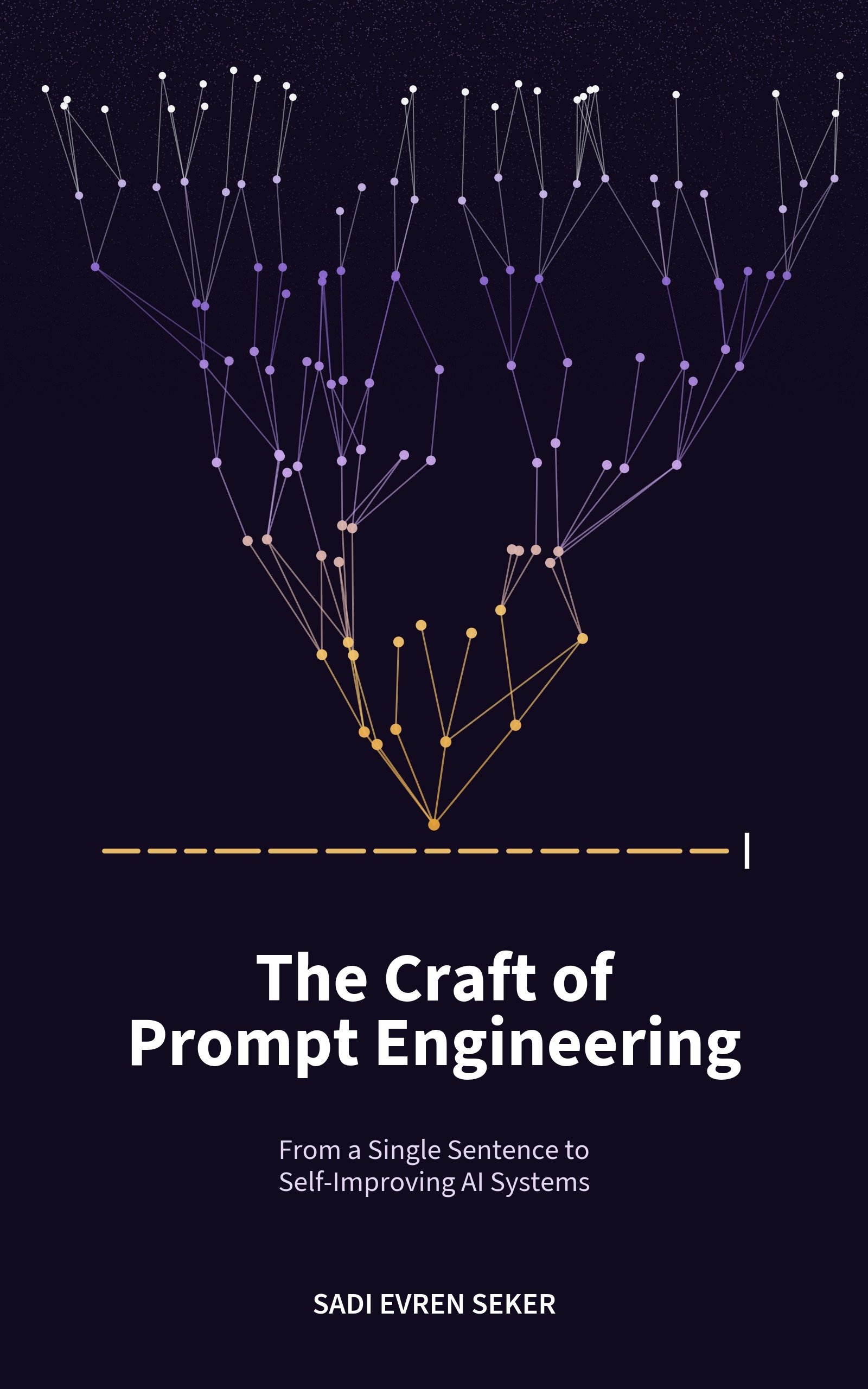
The Craft of Prompt Engineering: From a Single Sentence to Self-Improving AI Systems
Every message you send to a language model is an order carried to a reader who cannot see what you see. Every decision you leave open, the model makes for you: who it is writing for, how long, in what tone, and to what end. This book teaches you to make those decisions on purpose: the parts of a good prompt, why a prompt behaves like a small program, how to guide a model’s thinking, and how to move from single prompts to systems you can measure and test.
It does not teach the buttons of one app; chatbots change every few months. It teaches principles that work everywhere, and it dates every detail that depends on a particular product or model generation.
Who it is for
- Anyone who uses AI every day and wants better, more reliable results. No technical background is required.
- Developers and technical teams who want to build workflows, automations, RAG systems or agents with AI.
- Instructors and students. The book is designed to serve as a course textbook.
What is inside
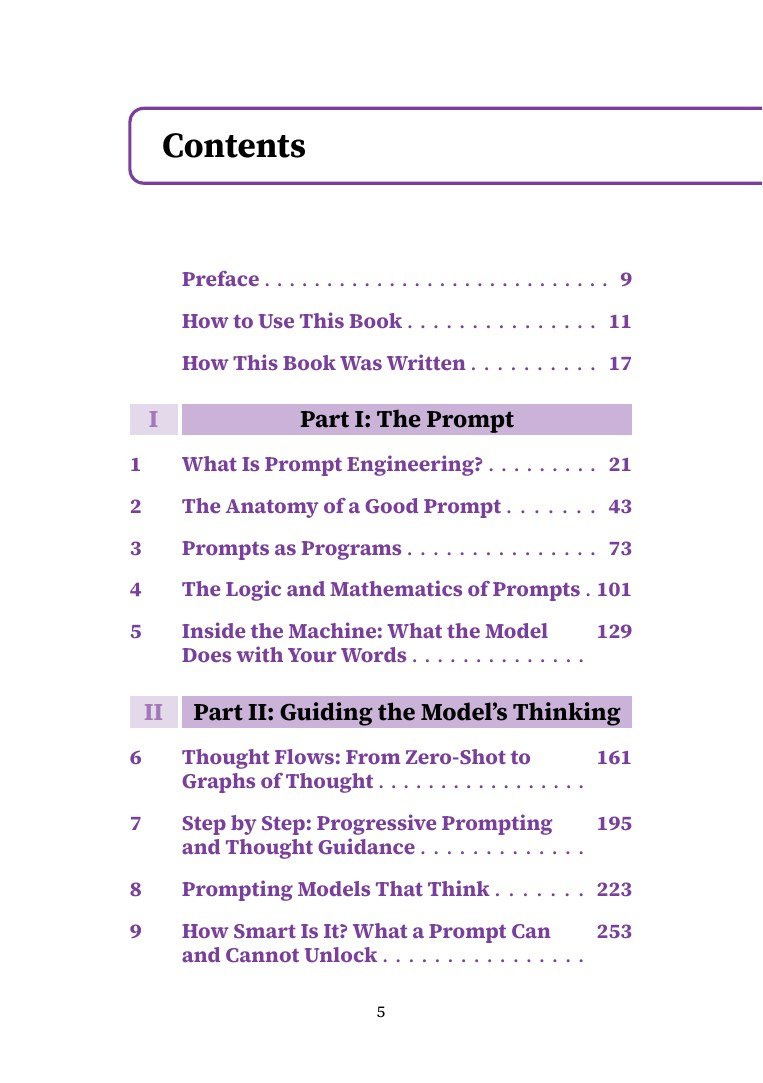
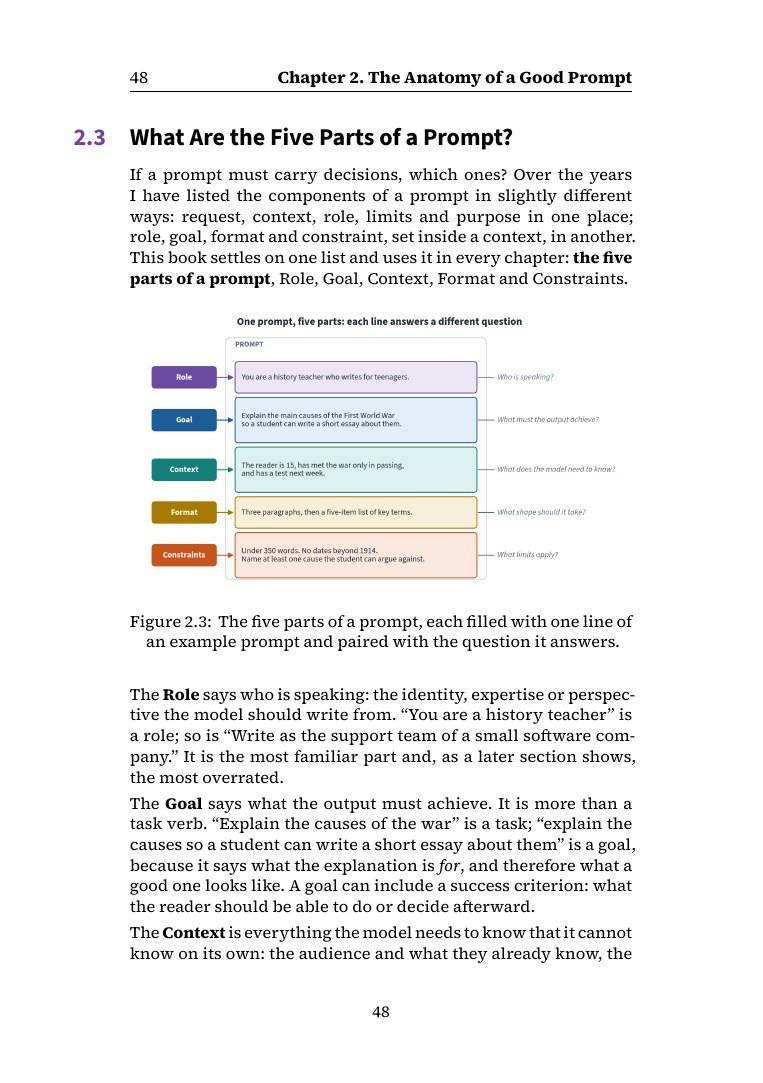
- Part I, The Prompt: what prompt engineering is; the five parts of a good prompt (Role, Goal, Context, Format, Constraints) and the What-How-Whom check; prompts as programs; the logic and mathematics of prompts; what the model does with your words (tokens, attention, temperature).
- Part II, Guiding the Model’s Thinking: from zero-shot and few-shot prompting to chain of thought, tree and graph of thoughts; progressive prompting; prompting reasoning models; what a prompt can and cannot unlock.
- Part III, Prompts at Work: coding with AI and coding agents; email, resumes and planning; creative work; multimodal prompts and data analysis; prompting for images and video; choosing and switching models.
- Part IV, Safety: guardrails and jailbreaks; prompt injection, privacy and secure design.
- Part V, Building Systems: context engineering; structured outputs, tool calling and MCP; AI flows with tools such as Zapier, Make and n8n; grounded answers with RAG; multi-agent systems.
- Part VI, Prompts That Improve: self-improving prompts; measuring and testing prompts; prompt compiling (DSPy and automatic prompt optimization); ethics and the future of the skill.
What makes it different
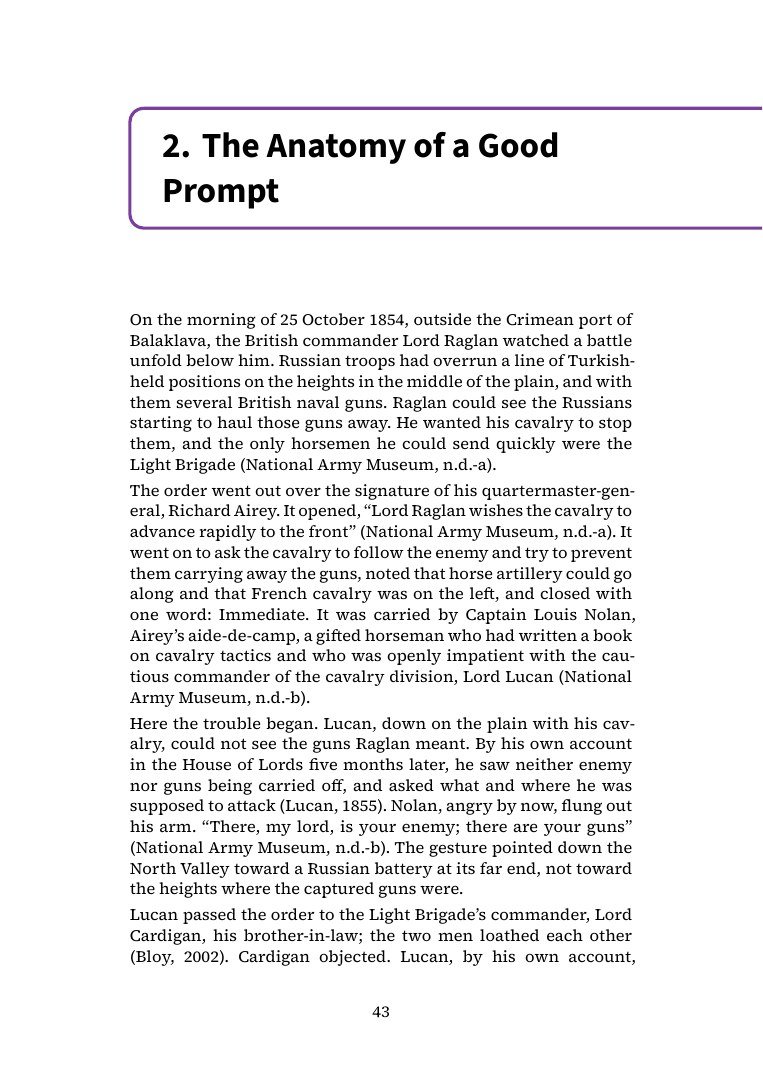
- Every chapter opens with a real, sourced story: the Light Brigade riding down the wrong valley on an ambiguous order, Clever Hans the “counting” horse, the Mars Climate Orbiter lost to a units mismatch, an automated trading system that went wrong for 45 minutes and cost its firm more than 460 million dollars, and Grace Hopper’s early compiler, which at first nobody would touch.
- 205 ready-to-use prompts. The main teaching device is the before-and-after pair: a weak prompt, what goes wrong and why, the improved prompt, and why it works.
- 25 case studies, 27 Real Story boxes and 144 original figures.
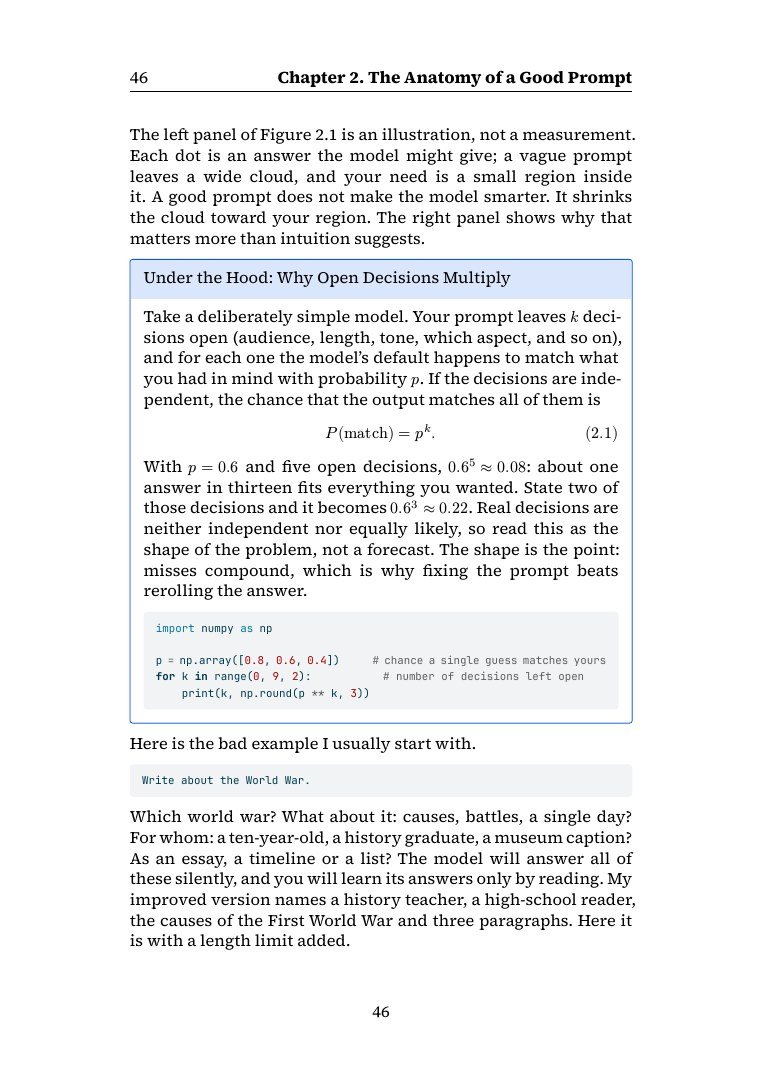
- 43 Under the Hood boxes hold the mathematics and Python code, all of which has been run. Examples that would call a model use an offline stand-in, so they run without an account or an API key. You can skip any box without losing the thread.
- Every chapter ends with a summary, key concepts, review questions, discussion questions and hands-on activities. The 296 quiz questions have explained answers at the back of the book.
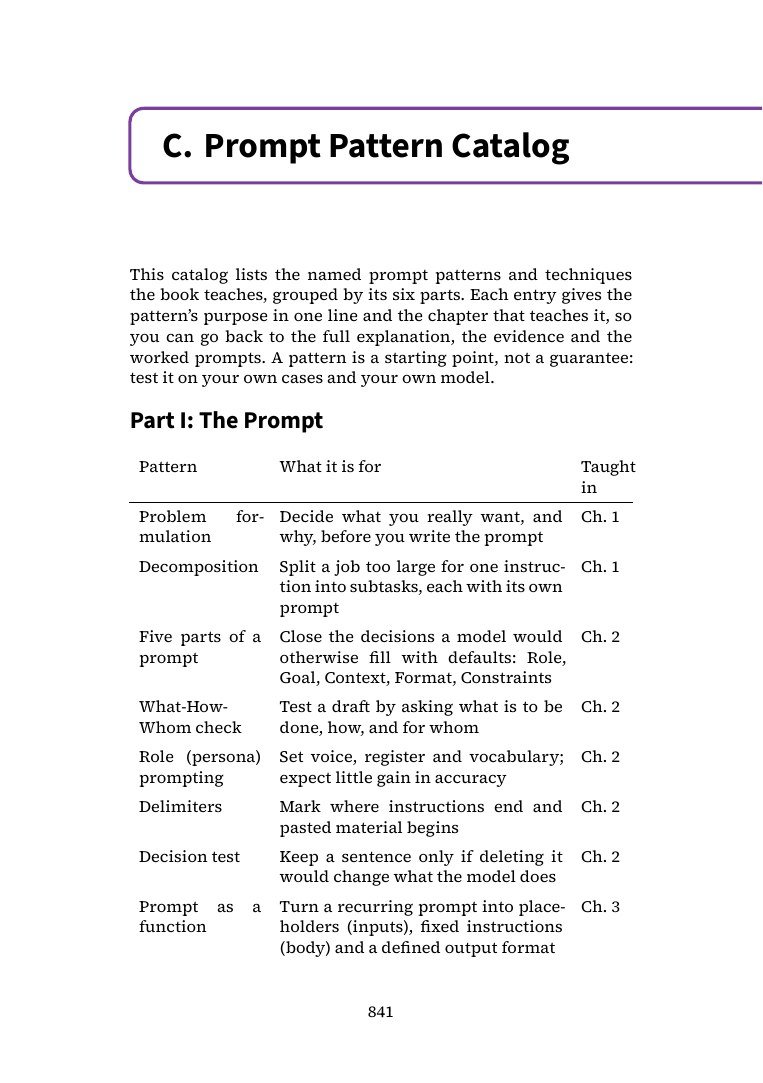
- A 295-term glossary and a Prompt Pattern Catalog listing the 71 patterns the book teaches, each with the chapter that explains it.
- Every factual claim rests on a source that was opened and read. Fast-changing facts (models, settings, prices, laws) are dated “as of late 2026”.
For instructors
The book includes a suggested fifteen-week course plan with two sessions a week. Instructors who adopt it can request the Instructor’s Companion, with model answers to the review questions, guidance for the discussion questions and case studies, and additional exam items for every chapter.
Book details
- Author: Prof. Dr. Sadi Evren Seker
- Language: English. The Turkish edition, İstem Mühendisliği Sanatı, is sold as a separate product.
- Edition: 2026. Facts current as of late 2026.
- Length: 851 pages: 26 chapters in six parts and three appendices (quiz answers, glossary, prompt pattern catalog).
- Format: Color PDF. After your order is complete, download it from the Downloads section of your account.
- Level: No prerequisites. Mathematics and Python are in optional Under the Hood boxes.
Frequently asked questions
Who wrote The Craft of Prompt Engineering?
Prof. Dr. Sadi Evren Seker. He has worked in information technology since 1997 and teaches artificial intelligence and computer science at the university level. The book grew out of his lecture series on prompt engineering.
Which AI tool does it work with?
Any of them. The prompts are deliberately tool neutral and work, with small adjustments, in ChatGPT, Claude, Gemini, Copilot or another chatbot. Almost every activity in the book can be done with a free chatbot.
Do I need a technical background?
No. The main text assumes no programming or mathematics. For readers who write code, the chapters on RAG, tool calling, structured output and evaluation go deeper, with working examples in optional boxes.
How is the book delivered?
As an 851-page color PDF. The file appears in the Downloads section of your account once your order is complete.
Can it be used as a course textbook?
Yes. Every chapter has a quiz, review and discussion questions and activities, and a fifteen-week course plan is suggested. Instructors can also request the Instructor’s Companion.
How current is it?
The facts were checked in late 2026. Wherever a model, setting, price or law appears, the text says when it was true, so the techniques and explanations stay useful when the details change.
Was AI used to write it?
Yes, and the book says so plainly. Its “How This Book Was Written” section explains how AI tools were used and how every claim was checked against its sources.
Is there a Turkish edition?
Yes. İstem Mühendisliği Sanatı, a 911-page Turkish edition, is sold as a separate color PDF.
About the author
Sadi Evren Seker has worked in information technology since 1997 and teaches artificial intelligence and computer science at the university level. His master’s and doctoral theses were in artificial intelligence, on natural language processing. He has worked as an academic, expert and consultant in six countries, and for many years he has taught computer science to a wide audience.
How AI tools were used in making this book, and how the content was checked, is set out in its “How This Book Was Written” section.





Değerlendirmeler
Henüz değerlendirme yapılmadı.